100% Bonus Depreciation Impact (Post-OBBB)
$500K equipment purchase, 37% tax bracket
Documentation Hierarchy for Audit Protection
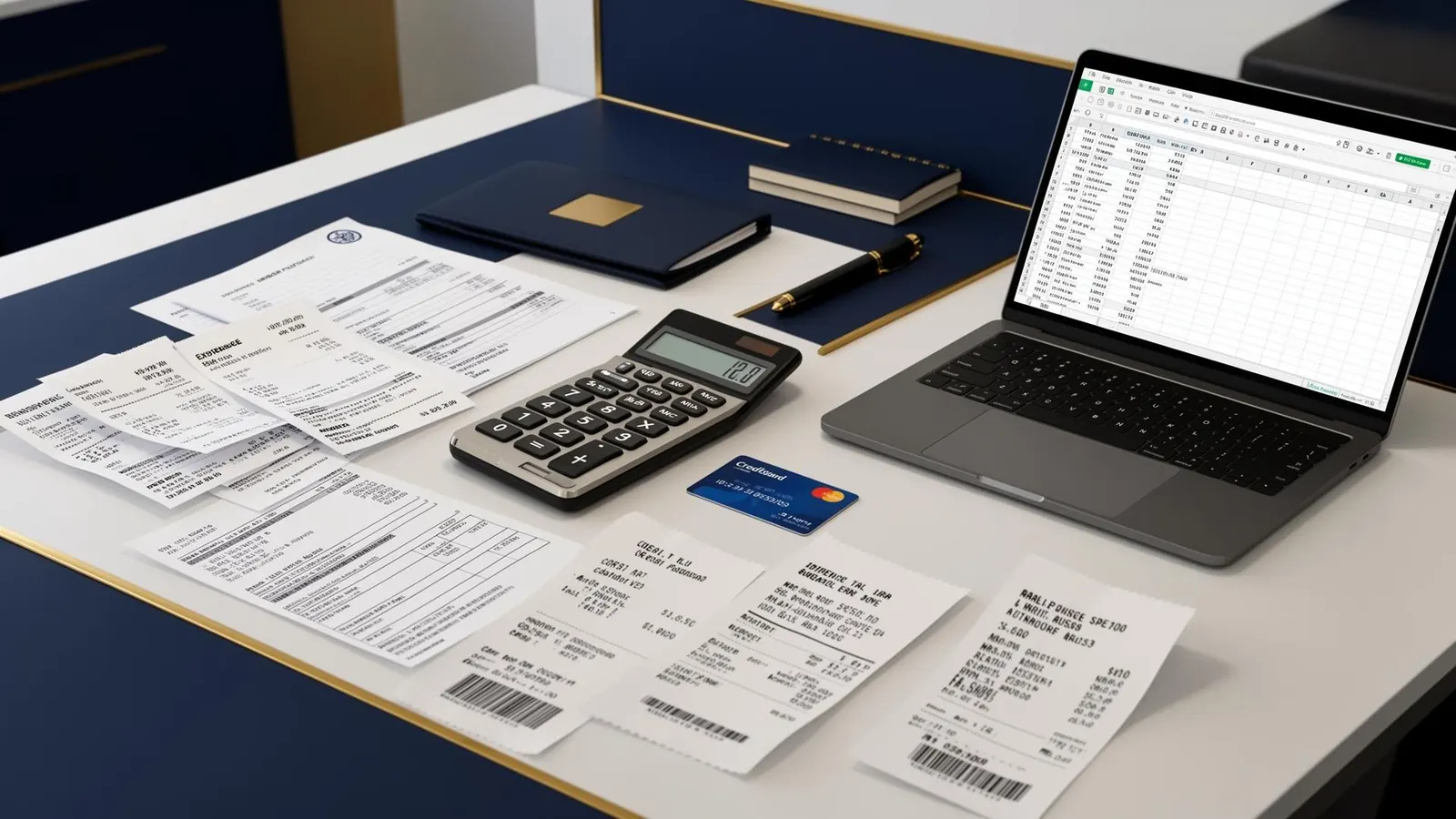
Credit Card Statement vs. Proper Receipt
Credit Card Statement Only
- Proves payment occurred
- Shows date and vendor
- No business purpose
- No attendee names
Corroborating evidence only—never primary documentation
Receipt + Business Purpose
- Shows specific items
- Documents business purpose
- Includes attendees
- Requires discipline to capture
- Needs same-day notation
All business expenses—the only reliable approach
Same-Day Documentation Process
Capture Receipt
Photograph receipt immediately using expense app with OCR.
Add Business Purpose
Note who attended, what was discussed, and expected business benefit.
Sync with Calendar
Ensure calendar entry reflects meeting purpose and attendees.
Categorize & Store
Assign expense category and store digitally for 7 years.
Introduction
Business expense deductions are one of the most powerful—and most misunderstood—tools in the tax code. When used properly, they can legally reduce your tax burden by thousands of dollars. When abused, they can trigger audits, penalties, and even criminal charges.
This guide covers everything you need to know about business expense categorization in 2025, including travel, meals, entertainment, and yes—even private jets. We incorporate the latest legislation including the One Big Beautiful Bill Act (OBBB) enacted July 4, 2025, which dramatically changed depreciation rules. We'll explain what qualifies, what doesn't, and how to document everything properly.
What Is a Business Expense?
The IRS defines a deductible business expense as a cost that is both ordinary and necessary for conducting your trade or business:
- Ordinary: Common and accepted in your industry
- Necessary: Helpful and appropriate for your business (doesn't have to be indispensable)
The Key Test
Before claiming any expense, ask yourself: "Would I incur this expense if I weren't in business?" If the honest answer is "no," it's likely deductible. If you'd incur it anyway, it's probably personal.
Example: A real estate investor flying to inspect a property they're considering purchasing = business expense. That same investor flying to Hawaii for vacation = personal expense.Why You Should NEVER Abuse Business Expenses
The Consequences Are Severe
| Violation | Penalty |
|---|---|
Negligence
| 20% of underpayment
|
Substantial understatement
| 20% of underpayment
|
Civil fraud
| 75% of underpayment
|
Criminal tax fraud
| Up to $250,000 fine + 5 years prison
|
Red Flags That Trigger Audits
The IRS uses sophisticated algorithms to detect expense abuse:
- Unusually high deductions relative to income
- Round numbers (e.g., exactly $10,000 for travel)
- Entertainment expenses without documented business purpose
- Lavish or extravagant expenses
- Vehicle expenses with no mileage log
- Mixed personal/business travel with 100% deductions claimed
The "Lifestyle Audit" Risk
When the IRS audits high-income taxpayers, they often reconstruct your lifestyle. If your claimed income doesn't support your visible lifestyle, they'll dig deeper. Claiming excessive business expenses while displaying wealth is a common audit trigger.
Travel as a Business Expense
Travel is one of the most valuable deduction categories—and one of the most scrutinized.
What Qualifies as Business Travel
For travel to be deductible, you must:
- Travel away from your "tax home" (primary place of business)
- Sleep or rest overnight (or long enough to require it)
- Have a legitimate business purpose
Deductible Travel Expenses (2025)
- Transportation (airfare, train, rental car, rideshares)
- Lodging
- 50% of meals while traveling
- Baggage fees
- Business calls and internet access
- Tips related to travel services
- Laundry/dry cleaning on trips longer than 5 days
The Mixed-Purpose Trip Rules
Primarily Business (Domestic)If your trip is "primarily" for business, transportation is 100% deductible, but you can only deduct expenses for the business days.
Example: 7-day trip where 5 days are business meetings and 2 days are sightseeing:- Airfare: 100% deductible
- Hotel: 5/7 deductible
- Meals: 5/7 deductible (at 50%)
If the trip is primarily personal, NO transportation is deductible, though you can still deduct specific business expenses incurred.
International TravelStricter rules apply. If you spend more than 25% of days on personal activities, you must allocate transportation costs proportionally.
The "Spouse Travel" Trap
Your spouse's travel expenses are only deductible if they:
- Are a bona fide employee of your business
- Have a genuine business purpose for the trip
- Would have traveled regardless of whether you did
Taking your spouse "for support" or because they help with "networking" generally doesn't qualify.
Meals as a Business Expense
The Tax Cuts and Jobs Act (TCJA) and subsequent legislation changed meal deductions significantly.
2025 Meal Deduction Rules
| Type of Meal | Deduction |
|---|---|
Business meals with clients/prospects
| 50%
|
Meals during business travel
| 50%
|
Employee meals for convenience of employer
| 50%
|
Food at company events (all employees)
| 100%
|
Office snacks and coffee
| 50%
|
Meals included in entertainment
| 0% (unless separately stated)
|
How to Make a Family Dinner a Business Expense (Legally)
Yes, it's possible—but the requirements are strict:
The Rules:- There must be a bona fide business discussion during or directly before/after the meal
- You must reasonably expect to derive business benefit
- The expense must be ordinary and necessary
- You must document the business purpose
- Dinner with your spouse who is a genuine business partner discussing partnership matters
- Family meal where adult children who work in your business discuss operational issues
- Dinner with a family member who is a prospective client or referral source and you discuss business
- Weekly family dinners where you occasionally mention work
- Meals with family members who have no business connection
- Personal celebrations called "business dinners"
- Date and location
- Names of attendees and business relationship
- Business topics discussed
- Business purpose and expected benefit
- Receipt
Entertainment Expenses: The 2025 Reality
Entertainment Is NOT Deductible
The TCJA eliminated the deduction for entertainment expenses starting in 2018, and this remains in effect for 2025. No amount of business discussion makes pure entertainment deductible.
What Counts as "Entertainment"
- Sporting events (seats, skyboxes, tickets)
- Golf and country club dues
- Concerts and theater
- Hunting/fishing trips
- Vacation properties used to host clients
The Meals Carve-Out
If you take a client to a sporting event AND separately pay for their meal, the meal portion MAY be 50% deductible if:
- Food/beverage is purchased separately from entertainment
- Food/beverage cost is stated separately on invoice/receipt
- You document the business discussion
- Tickets: $0 deductible
- Dinner: $100 deductible (50%)
Skyboxes and Luxury Suites
If you rent a skybox or suite that includes catering:
- The seat/rental cost: $0 deductible
- Food and beverages: May be 50% deductible IF separately invoiced at face value (not inflated)
Private Jets: When They're Deductible (And When They're Not)
Private jet travel has become a favorite topic of "tax gurus" on social media. Here's the reality—updated for the One Big Beautiful Bill Act.
When Private Jet Travel IS Deductible
For Legitimate Business Travel:If you use a private jet for bona fide business purposes, the costs can be deductible—subject to the same rules as any business travel:
- Trip must have a legitimate business purpose
- Travel must be "ordinary and necessary"
- Expenses cannot be "lavish or extravagant" relative to circumstances
If your business owns an aircraft used for business:
- Depreciation (5-year MACRS for most aircraft)
- Operating costs (fuel, crew, maintenance, insurance)
- Hangar fees
- Management fees
When Private Jet Travel Is NOT Deductible
Personal Use:Any personal use of a company aircraft creates taxable income to the user and is not deductible by the business.
Entertainment Use:Flying clients to events, hunting trips, or vacations = entertainment = $0 deductible.
Lavish or Extravagant:The IRS can disallow deductions if the expense is deemed "lavish or extravagant" under the circumstances. Flying private when commercial would suffice may be challenged.
The Social Media "Tax Guru" Trap
You've seen the videos: "Buy a jet, write it off!" Reality check:
- 100% bonus depreciation IS back (see below)—but only for legitimate business use
- Personal use creates taxable income and can trigger excess benefit penalties
- The "Augusta Rule" for jets is largely myth
- Aircraft ownership is complex and heavily audited
The One Big Beautiful Bill: Game-Changer for Depreciation
The One Big Beautiful Bill Act (OBBB), enacted July 4, 2025, permanently restored 100% bonus depreciation. This is a major shift from the phase-out that was occurring under TCJA.
New Bonus Depreciation Rules (Post-OBBB):
| Asset Acquisition Date | Bonus Depreciation |
|---|---|
Before Jan. 20, 2025 (placed in service 2025)
| 40%
|
After Jan. 19, 2025 (acquired AND placed in service)
| 100% (permanent)
|
- Property must be acquired after January 19, 2025
- Property must be placed in service after January 19, 2025
- Both conditions must be met—purchasing equipment in 2024 and installing it in 2025 only gets 40%
- Aircraft acquired and placed in service after January 19, 2025 qualify for 100% first-year depreciation
- A $5 million business jet used 100% for business can be fully deducted in year one
- This is PERMANENT—no more phase-out concerns
- BUT: Personal use still creates taxable income and disallowed deductions
Qualified Production Property: New 100% Deduction
OBBB also created a brand-new category: Qualified Production Property (QPP). This allows 100% deduction for nonresidential real property used in U.S. manufacturing, including:
- Manufacturing facilities
- Production buildings
- Processing plants
- New construction must begin after Jan. 19, 2025 but before Jan. 1, 2029
- Must be placed in service before Jan. 1, 2031
- Must be integral to manufacturing tangible personal property in the U.S.
Section 179 Expensing: Also Expanded
OBBB increased Section 179 limits:
- New Limit: $2.5 million (up from ~$1.2 million)
- Phase-out begins: $4 million
- Available for tax years beginning after December 31, 2024
- Section 179 has income limitations; bonus depreciation doesn't
- Section 179 can create or increase a loss; bonus depreciation can too (post-TCJA)
- For most large purchases, bonus depreciation is more flexible
Documenting Business Expenses: The Make-or-Break Factor
Documentation isn't just good practice—it's the difference between keeping your deductions and losing them entirely in an audit. The IRS requires "contemporaneous" documentation—records made at or near the time of the expense.
Do You Really Need a Receipt for Everything?
This is one of the most common questions business owners ask. Here's the definitive answer:
The $75 Rule:Under IRS regulations, you generally don't need a receipt for expenses under $75 (except lodging). BUT—and this is critical—you still need to document the expense with:
- Amount
- Date
- Business purpose
- Who was present (for meals)
| What Credit Card Shows | What IRS Requires |
|---|---|
Amount charged
| ✓ Amount
|
Date of charge
| ✓ Date
|
Merchant name
| ✗ Specific items purchased
|
—
| ✗ Business purpose
|
—
| ✗ Who attended (meals)
|
—
| ✗ Business relationship
|
—
| ✗ Topics discussed (meals)
|
- Corroborating evidence alongside other documentation
- Proving you were at a location on a specific date
- Backing up lost receipts when combined with calendar entries and contemporaneous notes
- Expenses under $75 when paired with a documented business purpose
If you're audited and only have credit card statements, the IRS may:
- Disallow deductions entirely for meals and entertainment
- Require you to prove the business purpose of every charge
- Apply the "Cohan rule" (see below)—but give you far less than claimed
- Assess negligence penalties if the pattern suggests poor recordkeeping
What the IRS Actually Requires
For All Business Expenses:- Amount
- Date
- Place/vendor
- Business purpose
- Names of all attendees
- Business relationship of each person
- Nature of business discussion
- Expected business benefit
- Dates of travel
- Destinations
- Business purpose of trip
- Who you met with and why
- Allocation between business and personal days
- Contemporaneous mileage log (date, destination, purpose, miles)
- Must distinguish business vs. personal use
- Odometer readings at year start and end
The Receipt Reality: What Courts Have Said
Recent Tax Court cases make clear that credit card statements alone don't cut it:
Sanford v. Commissioner (2020): Taxpayer's deductions disallowed because credit card statements didn't show the business purpose of expenses.Boyd v. Commissioner (2019): "A cancelled check or credit card statement is not sufficient to establish the business purpose of an expense."Taxpayer Takeaway: Courts consistently hold that credit card statements prove payment occurred, not that the expense was business-related.The "Cohan Rule" Is Not Your Safety Net
Some believe that without records, you can still claim "reasonable estimates" under the Cohan rule. Reality:
- Cohan doesn't apply to travel, meals, entertainment, vehicles, or listed property (these have specific statutory documentation requirements under IRC §274)
- Courts have become increasingly hostile to undocumented deductions
- Even where Cohan applies, you'll likely get far less than you claimed
- Relying on Cohan signals to the IRS that your recordkeeping is poor—inviting deeper scrutiny
Best Practices for Bulletproof Documentation
The "Same Day" Rule:Document expenses the same day they occur. Memory fades, and "I'll do it later" often becomes "I forgot."
1. Use an Expense Tracking App:Apps like Expensify, QuickBooks, or Zoho Expense let you:
- Photograph receipts immediately (with OCR data extraction)
- Add business purpose notes on the spot
- Categorize expenses in real-time
- Generate audit-ready reports
For every meal or expense, immediately note:
- Who was there
- What you discussed
- What business outcome you expected
Your calendar serves as corroborating evidence. Include:
- Meeting attendees and agenda
- Travel purposes
- Client names and topics discussed
- Use dedicated business credit cards
- Maintain separate bank accounts
- Never mix personal and business expenses on the same card
The IRS can audit up to 6 years back (for substantial understatements). Keep:
- Digital copies of all receipts
- Bank and credit card statements
- Calendar records
- Mileage logs
The Ideal Documentation Stack
For maximum audit protection, maintain this hierarchy:
- Original receipt (photographed/scanned same day)
- Written business purpose (noted immediately)
- Calendar entry (showing meeting/activity)
- Credit card statement (corroborating evidence)
- Bank statement (additional backup)
If you have items 1-3, you're bulletproof. Credit card statements are supporting evidence, not primary documentation.
Common Expense Categories and Their Rules
Home Office Deduction
Who Qualifies: Self-employed and gig workers only (W-2 employees cannot claim this)Requirements:- Regular and exclusive use for business
- Principal place of business OR meeting clients
- Simplified: $5/sq ft, up to 300 sq ft ($1,500 max)
- Actual expenses: Proportionate share of mortgage/rent, utilities, insurance, repairs
Vehicle Expenses
Two Methods:- Standard mileage: 70 cents/mile (2025)—includes gas, insurance, depreciation
- Actual expenses: Track all costs, multiply by business use percentage
Professional Services
Generally 100% deductible:
- Accounting and tax preparation
- Legal fees (business-related)
- Consulting fees
- Marketing and advertising
Education
Deductible if:
- Maintains or improves skills required in current business
- Required by law/employer to keep current position
NOT deductible if:
- Qualifies you for a NEW trade or business
- Meets minimum educational requirements
State-Specific Considerations
California
- Conforms to federal expense rules with some exceptions
- No deduction for qualified production expenses (entertainment/film)
- Home office deduction follows federal rules for self-employed
New York
- Generally follows federal expense limitations
- May have different treatment for certain pass-through entities
- City taxes may have additional limitations
Texas
- No state income tax = no state expense deduction issues
- Franchise tax may have different expense treatment for margin calculation
Florida
- No state income tax
- Corporate income tax applies federal expense rules generally
Audit Defense Strategies
If You're Audited on Expenses
- Don't panic—most expense audits are correspondence audits
- Gather documentation before responding
- Be organized—present information clearly
- Be honest—never fabricate documentation
- Consider representation—CPAs and tax attorneys handle audits regularly
Statute of Limitations
- 3 years from filing for normal audits
- 6 years if more than 25% of income is omitted
- Unlimited for fraud or failure to file
The Bottom Line
Business expense deductions are valuable and legal—but only when used correctly:
- Document everything at the time of the expense
- Keep business and personal separate
- Never claim personal expenses as business
- Entertainment is dead—stop trying to write off golf and sporting events
- Be reasonable—if an expense looks lavish, the IRS will think so too
- When in doubt, ask a professional—the cost of advice is far less than audit penalties
Take Action
Proper expense categorization requires systems, discipline, and professional guidance. Schedule a consultation to review your expense tracking and ensure you're maximizing legitimate deductions while minimizing audit risk.